
Memories on Wheels
Chapter 1: The Morning Bus
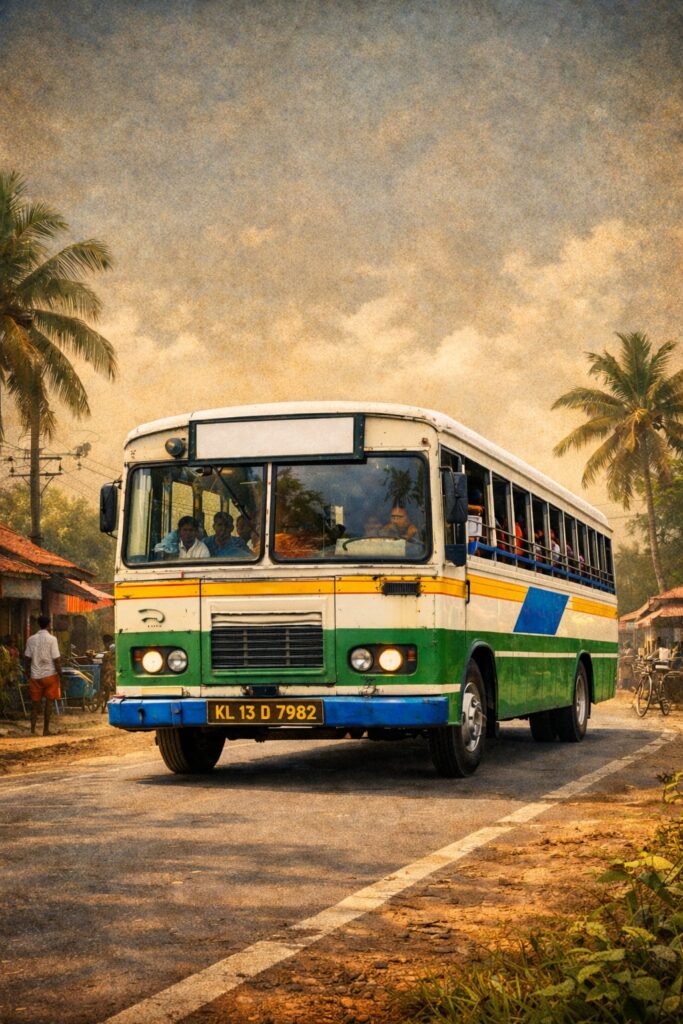
January 29, 2009
The morning bus to Arun’s school arrived every day at exactly 7:50 a.m. It stopped at the small village bus stop of Prapoyil for no more than two minutes—just enough time for a few hurried passengers to climb in before it disappeared down the narrow road that cut through the coconut groves.
For Arun, catching that bus was the first challenge of every day.
He was seventeen, in the final year of school, and his classroom was nearly twenty kilometres away from home. Most boys his age studied in schools close to their villages. They could wake up late, walk to class with friends, and return home before sunset. Arun did not have that privilege.
Ironically, his father was a teacher in the government school just a few minutes from their house—the same school Arun had attended until the tenth grade. But people around them had convinced his father that if Arun studied in a “better” school farther away, he would have a chance to compete with the brightest students.
His father, Radhakrishnan, was a man who believed deeply in progressive politics. He spoke passionately about equality, workers’ rights, and justice. Yet like many men shaped by the quiet traditions of his time, he also carried fears that logic could not easily defeat. Many times Arun felt that his father is a flag bearer of patriarchy who tries to act as progressive soul.
One of those fears had to do with a girl.
A few months earlier, Arun had written a poem about a girl in his school. It was nothing extraordinary—just the clumsy sincerity of a shy boy discovering emotions he didn’t fully understand. The poem had somehow found its way into his room, hidden among his notebooks. His father discovered it and quietly came to a conclusion: his son had fallen in love.
In truth, Arun had never even spoken to her.
He admired her from a distance, the way many boys his age admired someone quietly and safely, through poems and imagination. But to his father, the situation seemed dangerous enough. Sending Arun to a school twenty kilometres away appeared to be a simple solution.
Sometimes Arun wondered whether life would have been easier if he had just stayed in the nearby school—studied well, scored good marks, and perhaps one day gathered enough courage to speak to her after the twelfth-grade results were announced.
But life rarely follows the simple plans we make in our heads.
Arun was dark-skinned, something he had never thought much about as a child. He had once been a confident boy, curious and outspoken. But one evening he overheard his father telling his mother something that quietly changed him.
“It is good that our daughter is fair and son is dark” his father had said. If it is otheoway around, it would be difficult to find a match for our daughter, we might need to offer more dowry. Even though she is twelve. We have to start savings for her education and marriage from now on…”
A simple sentence which can can be the most scariest, racist and patriarchal sentence an ordinary man could be say it in a single line.
It was just a sentence—spoken casually, almost absentmindedly. Yet it carried centuries of unspoken prejudice: colour, caste, expectation, and the silent pressures of society.
That night something inside Arun shifted.
From that moment on, a small shadow of doubt followed him everywhere. The confident boy slowly retreated inward, becoming quieter, more observant, more uncertain of himself. The transformation happened so gradually that even he did not fully notice it.
Years later he would learn how deeply such small sentences can shape a person.
But on that particular morning in January, Arun had more immediate problems.
He was running toward the bus stop when he suddenly realised he had forgotten his bus pass.
He stopped mid-step.
Without the pass, the conductor would never let him travel.
Cursing under his breath, he turned around and ran back home, grabbed the pass from his study table, and rushed back toward the bus stop as fast as he could.
But by the time he reached there, breathing heavily, the 7:50 bus had already left.
The road was quiet again.
All he could do now was wait for the next bus or try his luck with the jeep drivers who usually waited near the shops. That morning, however, the jeep drivers were in one of their endless arguments with the bus operators and refused to take passengers.
So Arun sat down on the old cement bench at the bus stop and waited.
Prapoyil was a small but lively village in northern Kannur, a place known for its long history of resistance against caste oppression and feudal landlords. Political debates were as common as the sound of temple bells or church prayers. People here had a habit of questioning authority—a trait passed down through generations.
The bus stop stood beside a government high school and a row of tiny shops that sold tea, bananas, and cigarettes. Students gathered there every morning, while workers waited impatiently for buses that would take them to towns and markets.
Twenty minutes later, another bus appeared in the distance.
Something about it looked strange.
The bus had no destination board.
Normally, buses in Kerala displayed their route clearly on the front. But this one had its old board removed the previous day, replaced temporarily with a freshly painted wooden board. The paint was still bright white.
By the time people leaned forward to read where it was going, the bus had already arrived—and like every morning, it quickly filled with passengers.
Office workers squeezed in beside schoolchildren. Women carrying flowers for temples stood next to men heading to churches. Farmers, students, labourers—everyone pressed together in the narrow aisle.
Perhaps nowhere else in the world could one witness democracy and secularism in such an ordinary place as a crowded Kerala bus.
Inside that chaos, everyone somehow found a way to make space for each other.
Arun was pushed slowly toward the front as more passengers climbed in.
He grabbed a metal rod for balance and lifted his head to look around.
And then he saw them.
Two blue eyes.
Eyes he had seen once before.
Years ago.
So sincere writing of emotion. Beautiful usage of words. I really loved it bro
Great work.
”Arun the sage”
Not yet read fully, but could fetch out the soul. Just keep writing👍
Beautiful and filled with emotions. So different from my own upbringing.
Very nice and engaging … keep it up
Nice Writing Arun 🙂