
Memories on Wheels
Chapter 3: Wrong Questions
PART 3
By the colour of her uniform, he understood she would get down at the school that came halfway to his own.
He found himself looking at her again and again—careful, almost absentminded glances. She seemed to be inside her own world, untouched by the movement of the bus. Still, he knew—somehow—that she had looked at him too.
When the bus stopped at her school, she got down.
Even after reaching class that day, he couldn’t focus. Time moved, but not in a way that helped. From then on, he began arriving late on purpose—almost every day—just to catch that same bus.
Just to see her.
But how do you begin a conversation that has already lived inside you for years?
It had been nearly five years. She might not remember him the way he remembered her. Still, he carried small, quiet dreams during those days.
Rejection was something he had already decided he could not survive.
So he waited.
One morning, a thought arrived—simple and complete. He could get down at her stop. If she greeted him, maybe a conversation would follow. If not… that would be alright too.
He tried it.
To his surprise, she walked up to him.
“Hey… why are you here? Do you remember me?”
There were too many questions, all at once.
“Yes,” he said, trying to sound casual. “I’ve seen you on the bus. I thought I’d say hi… that’s why I got down here. If you have some time, maybe we could have a coffee?”
She smiled.
“Yes, definitely. I have about twenty minutes. I can catch the next bus.”
They went for coffee. The conversation unfolded gently, like something that had been waiting for years without knowing it.
He told her everything—from the day he left the school. She listened quietly, but there were moments when her eyes sharpened with interest.
Then she said, almost lightly,
“I still remember the temple trip… and the boat ride. And do you know something? The teacher married that same guy—the Christian one. I told you back then, didn’t I?”
“You’re a mind reader,” Arun said.
She smiled.
“Shall we meet sometimes?” he asked.
“I’d love to.”
“Will your boyfriend be okay with that?” he asked, carefully—like someone checking the depth of water with his foot.
She looked at him and smiled again.
“I don’t need anyone’s permission to have coffee with you. And… I don’t have a boyfriend.”
Something inside him loosened.
“Then my waiting was worth it,” he said, almost without thinking. “I’ve wanted to tell you this for years… I have feelings for you. I think I’ve been in love with you for a long time.”
The words left him before he could examine them.
She didn’t react immediately.
“In the past few months,” she said slowly, “when many of my friends started getting into relationships… I also felt like having someone. I even prayed for it.”
She paused.
“I’ve known you for almost a decade. Even after you left in eighth grade… sometimes, I thought about you.”
A waiter approached their table and asked if they needed anything else. She stopped speaking until he left.
Then she said,
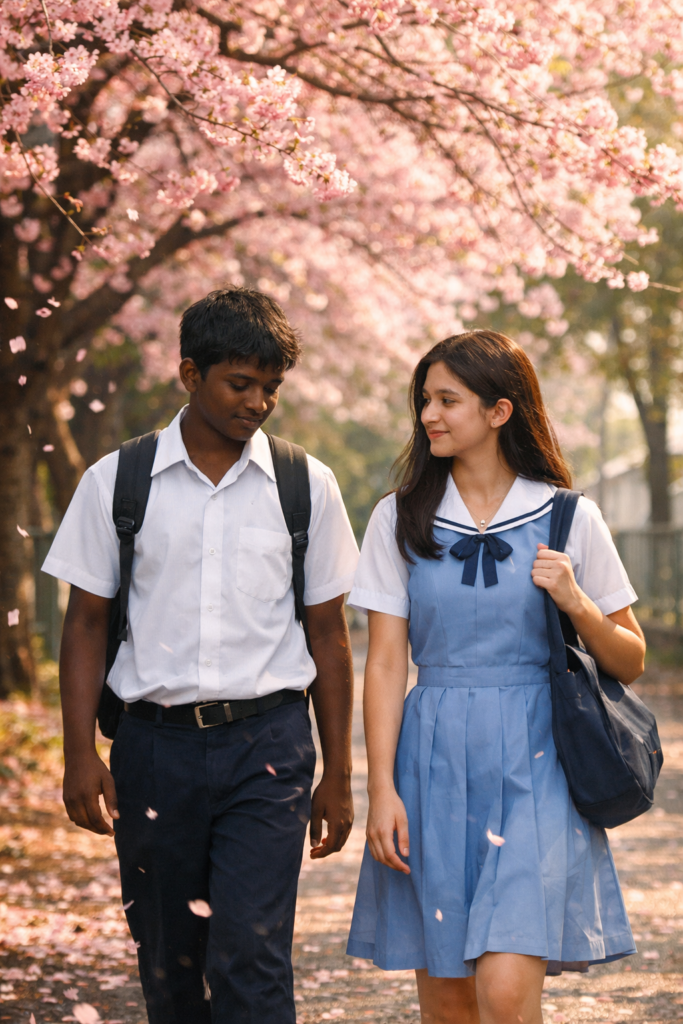
“Shall we take a walk? Near the school ground… there are trees in full bloom.”
He paid the bill and they walked.
For a long time, Arun said nothing. He was waiting—for those three words that seemed close enough to touch.
But instead, she said:
“I can never love you, Arun.”
The sentence settled between them like something that had always been there.
“Is it because I’m from another religion? Or… because I’m dark-skinned?” he asked, his voice carrying a quiet urgency, like someone trying to fix something already broken.
“No,” she said. “I’m scared of you.”
He stopped walking.
“You gave me the biggest wound I’ve ever had.”
He didn’t understand. Not immediately.
But he tried to speak—out of habit, out of instinct. She didn’t let him.
“Do you remember the day you asked me if my mother loved me?”
He nodded faintly. “It was years ago… I apologised too.”
She shook her head gently.
“After that… something changed inside me. I started feeling like my mother didn’t really love me. For years, I had nightmares of her leaving me. Even now, I feel uneasy when she shows affection to others. My cousins don’t like me anymore. Because some time I behave strangely when my mom tries to be friendly with them. Sometimes, even today, I ask her… if she’ll leave me.”
She looked at him.
“You were a bully, Arun.”
There was no anger in her voice. That made it heavier.
“But… when I told you that you were beautiful, you smiled,” he said, holding on to something small.
“I didn’t hear that,” she replied. “I was already somewhere else.”
The wind moved through the trees. Flowers fell quietly around them.
“It took me years to speak to you again,” she continued. “And… I do have feelings for you. But I can’t love you. Because you hurt me deeply once… and I’m afraid it might happen again.”
She paused.
“Fear and love don’t walk together, Arun. Even if I try… the fear will always return.”
He didn’t say anything.
A few drops of tears fell—from him, from the trees—it was hard to tell which came first.
For once, he didn’t feel like defending himself. He understood where he had been wrong.
A small boy, saying something without knowing its weight.
And yet… the weight had lasted for years.
“Can I at least be your friend?” he asked.
“You were always my friend,” she said.
He hesitated.
“Did you… overcome the pain that I caused?”
“Still trying,” she said.
They walked in silence for a while.
Then she asked, softly:
“Am I the only one you hurt like that?”
The question stayed with him—far longer than the conversation itself.
And together, without speaking, they walked toward the bus stop.
After a few minutes, Arun spoke again.
“Rachel… I thought it was just a joke. I said it to make others laugh. That question… was it really that wrong?”
She didn’t answer immediately. She kept walking, her eyes fixed somewhere ahead, as if she were reading something written in the air.
“Arun,” she said finally, “I’m studying history now… as my main subject.”
He waited.
“The more I learn, the more I realise…,” she continued. “Our world is full of wrong questions. Questions that should never have been asked… but still are.”
A light breeze moved past them. The fallen flowers shifted slightly on the ground.
“You asked only one,” she said. “Just one.”
She paused, then looked at him.
“Do you remember the tie-breaker question they asked us in that quiz?”
He tried to recall it, but the memory came back blurred, like an old photograph left in the rain.
“That,” she said, “was one of the worst questions I’ve ever heard. And yet… people ask such things with pride.”
Her voice was calm. Not angry. Not accusing. Just certain.
“That’s the world, Arun,” she said quietly. “It keeps asking the wrong questions… and teaches us to do the same.”
They reached the bus stop.
Neither of them said anything after that.
The silence, this time, felt different.
Good writing Mr. Arun. Keep going.