It was a Saturday afternoon, sometime after lunch.
I had reached a point in my life where, outside of work, there was nothing left that truly belonged to me. Productivity, I had discovered, was only real when someone was paying for it. Everything else — the hours between clock-out and sleep, between one Monday and the next — existed in a kind of pleasant, unnameable void. I was not unhappy. I was not happy. I was simply present, the way furniture is present in a room nobody uses.
I fell asleep on the couch without deciding to.
Midday dreams have a particular quality. They are not thin like the ones that come just before dawn, those pale, forgettable things that dissolve the moment your eyes open. Midday dreams go deep — the way the ocean goes deep before you even notice the light fading around you. They pull you under slowly, and by the time you realise you are drowning, you no longer want to come back up.
In the dream, I was in my hometown.
I could not read the date on anything. The clocks were there — mounted on walls, above doorways, fixed to the iron posts lining the main road — but the numbers refused to arrange themselves into meaning. Time existed, I understood, but it did not apply to me. My hair had gone gray. So had my moustache. I found my reflection in a shop window and stood looking at it for a long while. So this is what that looks like, I thought, without any particular feeling about it.
The village had not changed much. Or perhaps it had changed completely and I was simply too old, even in the dream, to notice the difference. There were gates everywhere — iron gates with rust at the hinges, wooden gates freshly painted in greens and blues, gates that suggested privacy, care, a life tended from the inside. The people I passed on the road were extraordinarily polite. They nodded. They smiled with their whole faces. In dreams, people are sometimes more real than real people. These were those kinds of people.
This is a place where you can be invited. That was the phrase that came to me, rising up from somewhere below thought. A place where you could be invited.
I knew a few of the houses. I began walking toward one — the way you walk in dreams, with full intention but uncertain legs, as if the ground keeps making small adjustments beneath you. I wanted tea. I wanted to sit across a familiar table and talk about nothing in particular — cricket, the rains, someone’s nephew who had moved to the city. I wanted gossip, the comfortable kind that means you belong somewhere.
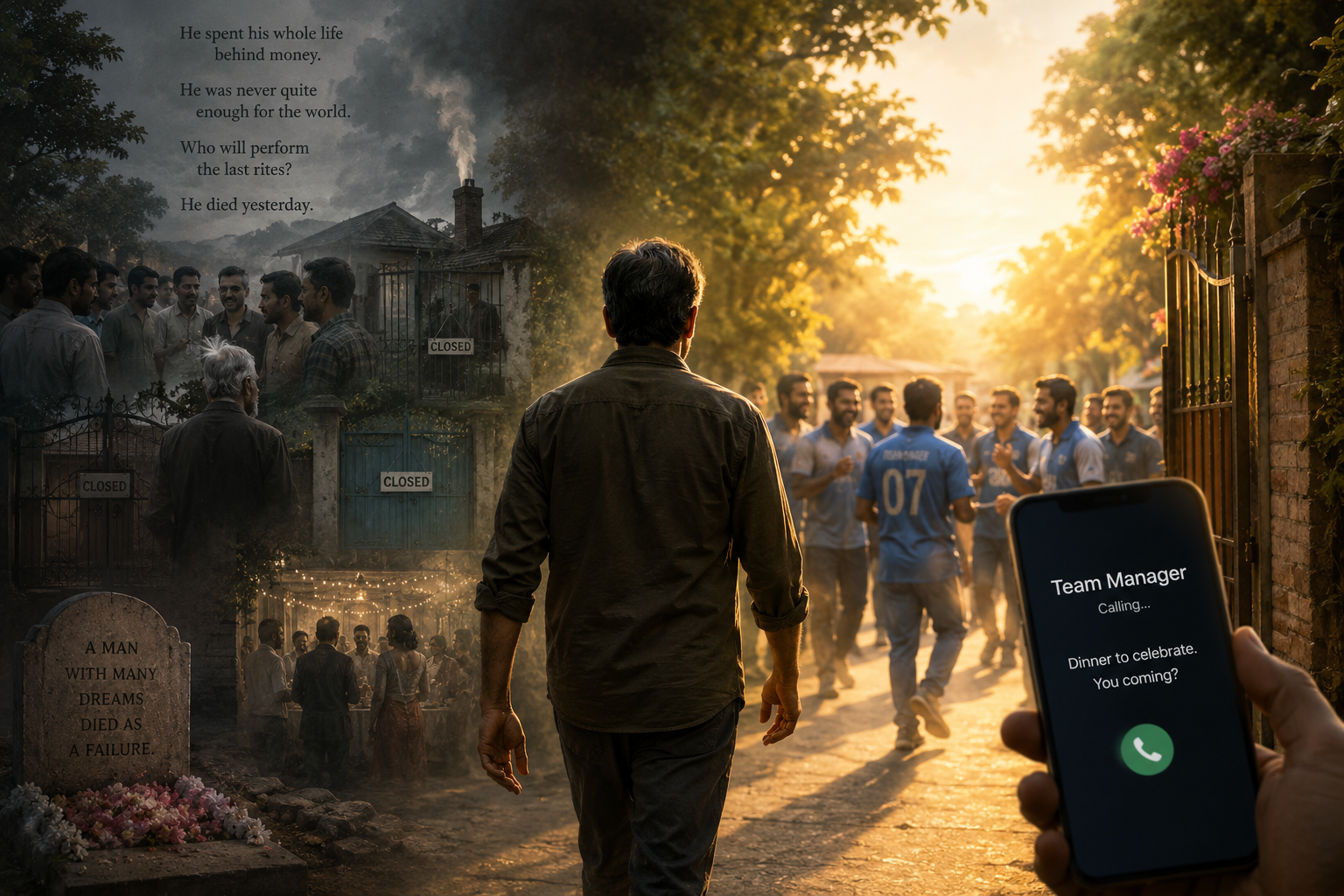
But the gate was closed.
I rang the bell and waited. Nobody came. From somewhere behind the wall, a thin thread of smoke rose lazily from the chimney. The house was occupied. The fire was lit. They simply chose not to hear the bell.
I told myself it was fine. I tried the next house — a friend’s place, just adjacent, separated by a low hedge. As I pushed the gate open, I heard voices from inside. I stood very still on the threshold, the way you stand when you realise you are hearing something not intended for you.
They were discussing a naming ceremony. A new child had arrived in the family. They had invited only the dearest, only the nearest, someone was saying — and the uninvited, the voices agreed, with great pleasantness, could simply be avoided. There was no malice in the words. That was the worst part. Exclusion, delivered with the same warmth as an invitation.
I understood that they were talking about me.
It was not paranoia. It was the clean, simple logic of a dream, where things mean exactly what they are.
I had more stories than I knew what to do with. So I walked further — to a relative’s house, a man who had first been my friend and then, over years, had become something closer to family. He had the sweetest smile I had ever seen on a person, the kind that makes you feel like the room got warmer. He was celebrating. Sweets were being distributed. He was dancing with people I did not recognise — new friends, perhaps, or relatives from branches of the family I had never met. I stood at the edge of the courtyard for a long time.
He did not see me. Or perhaps he did, and looked away in the manner of someone managing a busy afternoon.
I walked back.
Outside my own house, there was a crowd. This surprised me. People stood in clusters, speaking in the urgent, hushed tones of those who have gathered around something unfortunate. Someone was complaining about the excess salt in the idly that had been served. Someone else was debating over which relative was suitable enough to perform the cremation rituals.
Then I heard it.
He spent his whole life behind stupid ideologies. That is why he never built a family.
He was never quite enough for the world.
Who will perform the last rites?
He was a man with many dreams. He died a failure.
And then, quieter than the rest, as if it were simply a fact being noted for record:
He died yesterday.
I stood very still at the edge of my own crowd.
A man with a lot of dreams died as a failure.
Failure?
Death?
Is this what the world would say about me on the day I died? Would they gather outside my house and complain about the salt in the food while my body grew cold? Would the question of my children — the ones I never had — matter more to them than anything I had ever done or felt or tried to build?
And then, beneath that:
Which is the dream? Which is the reality?
Perhaps they are the same room, I thought. Perhaps we move between them without ever noticing the door.
Something broke inside my chest. Not dramatically. It broke the way a cup breaks when it falls on carpet — felt more than heard, a quiet internal collapse that leaves no visible mark. I could not breathe. I was suspended between the dream and whatever lay on the other side of it — neither dead nor quite alive, neither there nor entirely here. A man at his own funeral, invisible, listening to his own eulogy, unable to contest a single word.
Then my phone rang.
I surfaced. The ceiling of my apartment came slowly back into focus — the familiar crack near the light fitting, the water stain I had been meaning to report. The couch beneath me. The half-drunk glass of water on the table.
I was alive. It was a Saturday.
The call was from my cricket team manager. There was noise in the background — laughter, the bright, disorganised chaos of people who have just won something together. They were going to dinner to celebrate, he was saying. The whole team. Was I coming?
I lay there for a moment with the phone against my ear, looking at the ceiling.
I was not dead.
And somewhere in this world, on this ordinary Saturday, someone had thought of me and picked up their phone.
I was out the door in ten minutes, still adjusting my collar on the staircase, walking faster than was strictly necessary — as if the evening might close its gates before I could reach it. As if the invitation had an expiry. As if being alive were itself something that required a little urgency, a small daily act of showing up before the smoke disappeared from the chimney and the voices went quiet inside.
The afternoon light was long and golden over the street.
I walked into it.
And later, much later, when I thought about that afternoon — the dream, the closed gates, the crowd outside my own house, the voices reciting my failures over cooling idly — I understood something about the nature of dreams that I had not understood before. They are not prophecy. They are not memory. They are the mind’s way of taking you to your own funeral while you are still alive, so that when you wake — when the phone rings, when someone calls your name across a noisy room, when a door opens that you did not expect — you feel it fully. The gratitude. The shock of continuation. The strange, quiet joy of a man who has already died once today and is now, incredibly, walking toward dinner in the golden light of a Saturday evening, adjusting his collar, alive.