
Memories on Wheels
Chapter 4: A Bicycle Ride to the High Hill
A few weeks went by, and nothing in particular happened.
Still, Arun had the feeling that something was missing. Not lost, exactly. More like a door he had walked past a thousand times without noticing it was a door. He couldn’t put a name to it. He only knew it was there, the way you know a clock has stopped not because you heard it stop but because the room has gone too quiet. It wasn’t the end of anything. He was fairly sure of that. But he couldn’t fix his attention on his books, or on anything at all.
It was a Saturday.
He decided to go to Deva’s house. Deva lived about a kilometre away, through the rubber and the coconut estate, and to get there you had to walk a path Arun had known since he was small. The rubber trees stood in their straight, patient rows, the way they always had, leaking their slow white milk into little cups. The last two hundred metres he always ran. He didn’t know why. He had run them since childhood, and it had never once occurred to him to walk.
Deva was two years older than him. He played football, and when they played cricket he made sure that no one troubled Arun and that Arun got to bat. He was in his first year of college now. He was the confident kind, the kind of boy who takes it upon himself to protect the smaller ones around him, without ever being asked and without expecting thanks. Arun had always been the opposite. He kept his wants to himself. He was the sort of person who, in some quiet corner of himself, was forever dreaming that a guardian would arrive — someone older, someone steady, someone who would stand between him and the world. For a long time, Deva had been that person. He was Arun’s hero, though Arun never told him so. You don’t tell people things like that.
Deva was sitting on the verandah when Arun arrived. A football lay next to him like a sleeping animal. His club had a match the following week.
Arun didn’t waste time. He went straight up and asked, “Should we go somewhere?”
Deva thought about it for a second.
“I had a plan to go up the hill near the next station,” he said. “It isn’t easy, though. There’s no simple way up. We take the cycles, an hour through the forest path, then we leave them and walk another hour and a half to the top. It’s the highest hill around here. Some people say there’s a tiger up there.” He shrugged. “Maybe they’re lying. But maybe it’s there.”
He said this the way you might mention rain. A tiger, or no tiger. The hill didn’t care either way.
“If we leave in the next hour,” he went on, “we’ll make it for the sunset. From the top you can see all the hills, the near ones and the far ones, and beyond them the sea. The way the light falls — it’s a beautiful thing. But honestly, for me it isn’t really about the sunset. I like the going. The cycling. The climbing. So let me finish my lunch and you can join me on the way.”
“It’s fine,” Deva said. “You can eat here.” And before he could say anything else Deva had turned his head and shouted into the house, in that big easy voice of his, asking his mother for two plates of lunch.
Then he added, “We’ll call Hulk on the way, too.”
“Hulk? Who’s Hulk?”
“My classmate. His real name is Nithin. But he’s a fat one, strong, built like a wall. We call him Hulk.”
Arun had never met him. But the name caught on something inside him and held.
He thought of a quiz question he had once read. Cassius Marcellus Clay Jr. — that was a man’s real name. Who was he? And he thought of Rachel, of the last time they had talked, when she said to him, quite gently, Do you know, Arun, that Muhammad Ali changed his name because the old one was a slave name? And yet people still ask the question the old way. They still ask the wrong questions. Even the things people have tried to leave behind, others keep handing back to them. They give a man a nickname for the size of his body, for the shape of his face, and they think they are being friendly. Aren’t we wrong about that? he thought. Aren’t we always a little wrong?
He wondered whether Hulk liked being called Hulk. Whether anyone had ever asked him. Then the lunch came, and he let the thought go, and they ate.
They ate quickly. The cycles were old — neither of them was new — but they worked, and they each had one. Arun ran home first to tell his mother he was going on a day trip somewhere nearby and would be back by evening. He didn’t wait to hear what she said. Some part of him didn’t want to give her the chance to say no.
Then they started up the road.
It was a mud track, and it climbed. It took everything they had in their legs, but there was a destination, and there was a time limit, and those two things together can carry you a long way. They had forgotten to bring water.
“We’ll get it from Hulk’s place,” Deva said.
And so Arun met him for the first time. Hulk was older than them, bigger than them, a rude man in his manner but with a kindness somewhere back behind his eyes, the way a light can be on in a room at the far end of a house. For years afterward his home would be a place where Arun stopped for water, for food, for rest. But that day he only knew him for an hour. The two older boys rode ahead and didn’t talk much. Ride faster, they kept telling him. Ride faster. He felt like a boy out hiking with two older brothers, except that brothers might have explained things, and these two explained nothing. They simply rode.
They finished the slope and came into a stretch of forest loud with birds. There was a small stone temple there, almost empty of people. Arun went in and prayed while the others stood outside, talking about whatever they were talking about. He prayed for Rachel. He didn’t know exactly what he prayed for. Just that things would be well with her, wherever she was. And it gave him a kind of quiet he hadn’t had in weeks.
Further along, the cycle chain slipped off. They still had a long way to go. They stopped and crouched in the dirt and fixed it together, getting black grease on their fingers, and then they went on. A thing breaks, and you fix it, and you keep going. That was all there was to it. Arun remembered thinking that even then.
Deva was training for a running competition, and he talked about his preparation as they rode — the distances, the mornings, the discipline of it. Arun listened to about half of what he said. Deva must have noticed, because at some point he turned and said, “I don’t know what’s going on inside your head. But you’re seeing these hills and valleys for the first time in your life. If you let your thoughts get in the way of your eyes, you’ll never see them. Not properly. Not ever.”
Arun didn’t answer. But he thought he accepted it. He looked around. They were about halfway. The coolness of the mud road seemed to rise up through the soles of his feet and travel all the way to the top of his skull, and he let it.
They stopped to rest. Hulk turned out to be all right, in his way — a cool one, Deva said, who liked a good fight. He told them about a fight he’d had at school once, telling it slowly, with a kind of fondness, the way other people tell you about a holiday.
After that came the river. You couldn’t take the cycles past it. They left them in a place by the bank and started walking, one step and then another step, the simplest thing in the world. There was a cross there, and a temple. The Christians carried the cross up over the hill, the way Christ carried his, as a way of remembering. The Hindus walked their pilgrimage toward the temple. Two gods, side by side on the same hill, getting along fine. Neither seemed troubled by the other. Arun found that he liked it there.
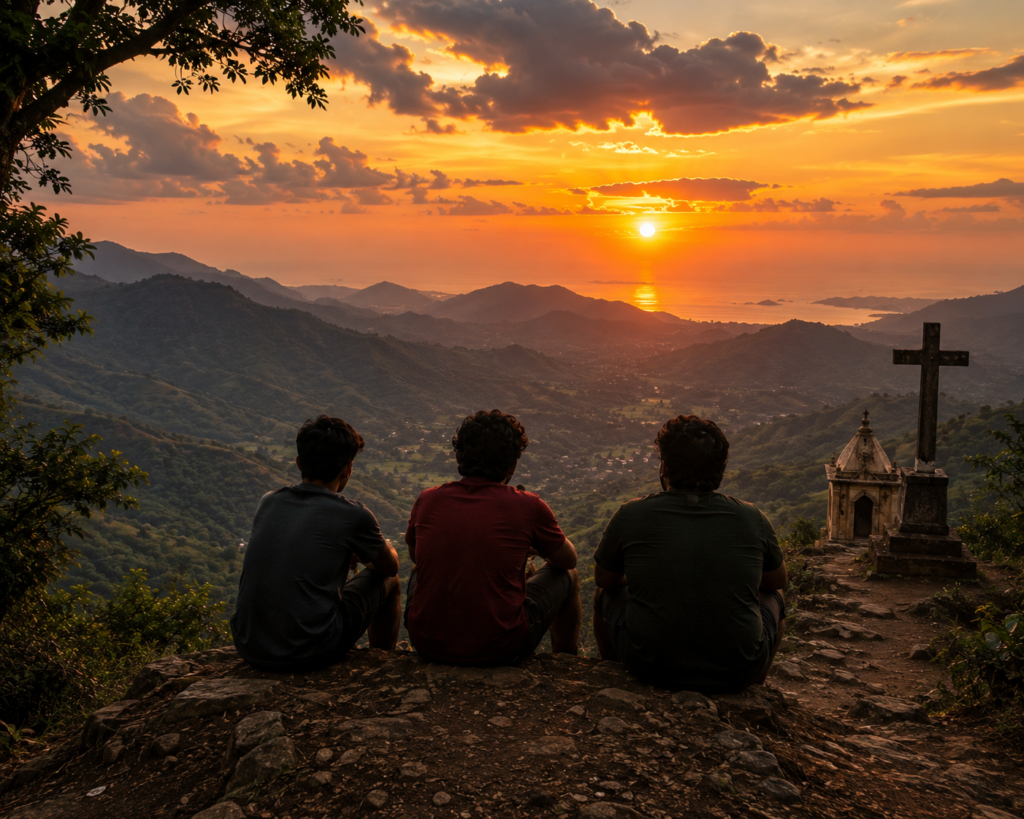
They walked for hours, and they reached the top around six in the evening.
The sun was about to set. And only then did it occur to them that they had completely forgotten about the way back. It would be dark soon. The stars would be out, and they had a torch, and the two of them would guide them, but the forest path at night is not a small thing. Still, it could be beautiful. To have the sunset, you had to agree not to think about the return. And if the way down turned out to be too much, Deva said, there was a church nearby where they could sleep the night.
Then the breeze came up over the hills, and the golden hour broke across their faces all at once.
Every flower in the valley seemed to lift its head, ready to say goodbye to the sun. The sun went down behind the seven hills, lowering itself toward the Arabian Sea, and for that one moment Arun was completely there. He wasn’t thinking about anything. Not Rachel, not the door he’d been unable to find, not the questions he kept asking wrong. For the first time in his life he watched a sunset and nothing came between him and it.
And it seemed to him that whatever had been missing, and all his small doubts, and all his confusion — they went down quietly over the edge of the world along with the light.