After a few years, living alone stopped feeling like an exile and became my routine.
I never asked my friends to stop calling. I just let their calls ring out until the screen went dark and left their messages unread. Gradually, the reach-outs slowed down, and eventually, the silence became permanent.
The biggest mistake of my life was meeting her. Even when she sat right beside me, I had a habit of missing her before she was even gone. When she married someone else, it tore open something quiet and hollow in my chest, but deep down, relief followed the heartbreak. We were never meant to share a horizon anyway. People are only visitors in our lives; you cannot force an open door to stay shut.
I sat at my desk and pulled up a blank document on the laptop.
These days, writing had an unvarying geometry: a sip of cheap whiskey, my favourite songs playing quietly in the background, and words slowly filling the white space. I had avoided alcohol most of my youth, but lately, that small burn offered a brief, quiet kind of comfort.
Some people write because they dream of holding their first printed novel. I wrote because my thoughts had grown too loud to keep inside. The world was always moving too fast for patient conversations, so I poured everything into letters instead—notes of longing, cold anger, and quiet confessions. Hundreds of them, sent out into the world, knowing none would ever receive a reply.
It was a Wednesday night. Midweek. Outside, the city lights blurred beneath the thirteen floors of quiet. Room number 13. Superstition had kept the rent low, and right then, cheap rent suited my thin pockets.
On the table lay my rough draft for the final chapter of a novel. I had been wrestling with the connection between the two lead characters, wondering why they felt so tied to each other’s fates. But if you try to dissect every emotion with logic, you strip away the magic. They were connected because they understood each other in silence, they started talking with eyes.
The story was moving well. Not perfect, but alive.
I leaned forward and scribbled one last line at the bottom of the page:
I owe nothing to the world beyond these pages.
A sudden, violent blow struck the back of my skull.
The room spun. My elbow caught the heavy tumbler, sending ice and whiskey splashing across the manuscript pages as my knees crashed onto the floor. Before my hands could break the fall, a cold weight snapped hard around my throat.
A rusted iron chain bit deep into the skin beneath my jaw.
Air vanished from my lungs. I kicked blindly against the floor, fingers clawing frantically at the rough metal links. Looming directly over me in the shadows was a face of melted, blackened flesh, with one bloodshot eye glaring down with absolute hatred.
My right hand was still curled around my heavy metal pen. With all the strength left in my shoulder, I drove the steel nib straight into his burnt wrist.
He hissed—a sharp sound, like green timber spitting inside a bonfire. The pressure around my throat loosened for half a second.
I wrenched myself sideways, rolled hard against the wooden edge of the bed, and scrambled up onto trembling legs. My chest heaved, my throat burning with the taste of copper and bile. I raised the ink-stained pen like a small knife.
“Who sent you?” I wheezed, shaking.
The intruder rose slowly. He didn’t rush. He moved with a heavy, uneven limp, leaving faint smears of soot across the floorboards. The air in the room instantly turned foul with the stench of hot diesel, scorched rubber, and wet earth.
“Nobody sent me,” his voice scraped like dry gravel grinding under a boot. “A debt collects itself.”
I lunged forward to keep distance between us, but his burnt fingers clamped around my wrist with unnatural strength, twisting until the pen clattered onto the floor. Before I could pull back, he shoved me hard, slamming my spine against the wall with enough force to knock the breath out of me.
He leaned in close, pressing his blackened thumb directly into the faint, pale marks beneath my jawline.
“Look at me,” he whispered, his breath hot with ash. “Look closely at the burns. You know where this fire started.”
A sharp prickle ran through the old scars—two faint marks I had carried for twenty years and always dismissed as childhood scratches from sleep.
“I don’t know you,” I gasped, kicking out at his shins.
He didn’t flinch. Instead, he wrapped the cold iron chain back around my neck, pinning my head flat against the wall.
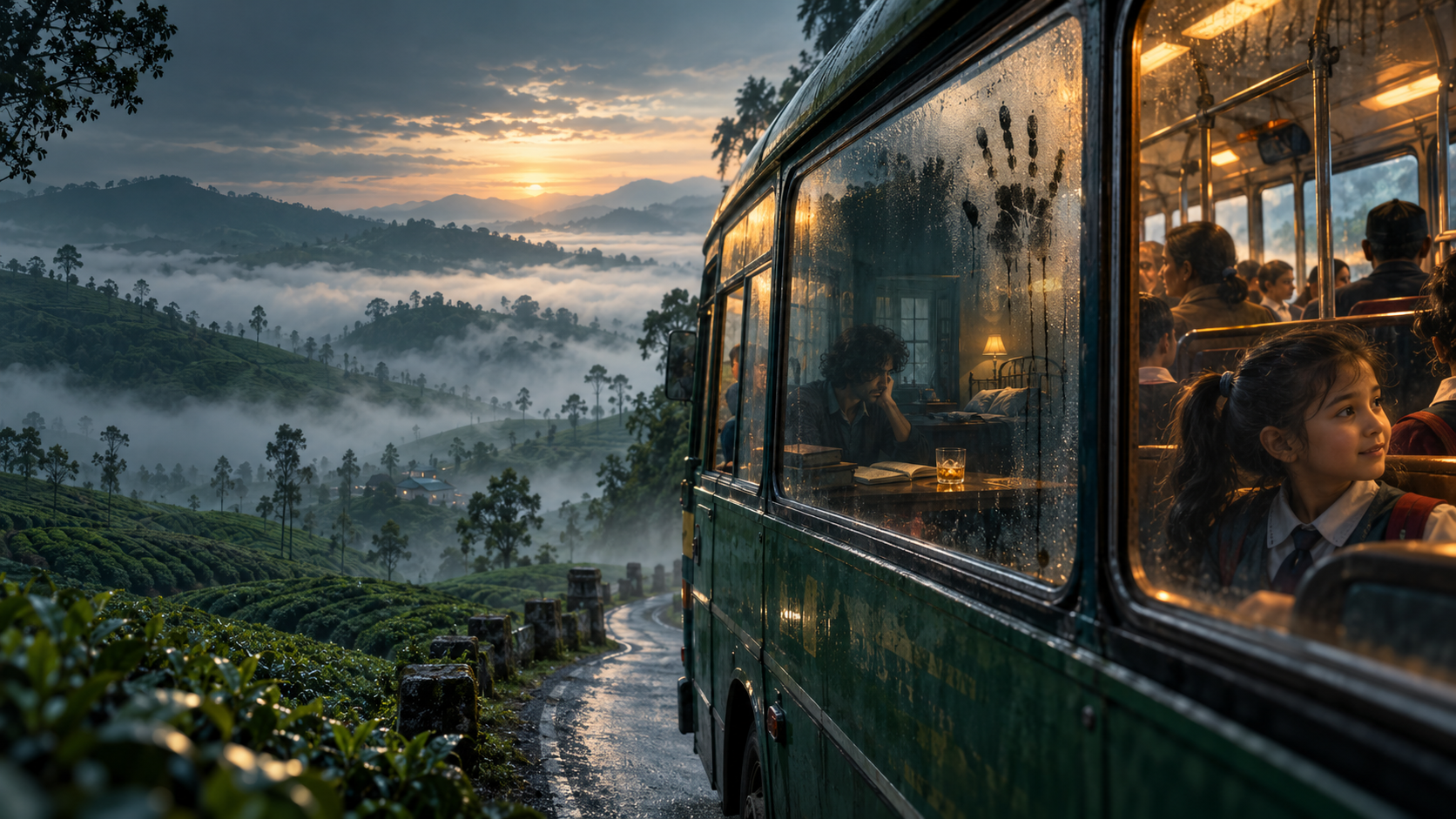
“A Tuesday morning in the tea gardens,” he said softly, tightening the chain link by link. “The valley mist just beginning to lift. An old Tamil love song playing from the bus driver’s front speaker. Forty ordinary people packed onto the benches, thinking about work, breakfast, and their children.”
A sickening chill swept through my stomach.
The green bus.
“You were standing in the very last row,” his scarred face hovered inches from mine. “Staring ahead through the crowd at a schoolgirl in a yellow dress. Shining eyes. Braces on her teeth. You were too scared to walk up and say a single word. So what did you write in that little blue notebook every evening?”
13 Dreams.
The memory surfaced with violent clarity. The cheap blue paper cover. The childish handwriting in black ink. The daydreams I wrote before falling asleep.
“A sharp turn on the ghat road,” he snarled, throwing his entire weight against my chest until my ribs groaned. “A snapped steering rod. You flipped that bus three times down the rocky cliff. My mother was crushed beneath the engine. My little sister suffocated on broken glass. Forty families wiped out in an instant.”
Dark spots swarmed across my eyes as the chain cut off the last drop of air.
“And why did forty people have to die?” his voice trembled with twenty years of buried fury. “Just so you could climb out of the shattered window without a single scratch on your uniform. Just so you could pull her out into the grass, play the miracle hero, and earn a kiss of gratitude.”
He pressed the rusted iron deeper into my throat.
“You butchered an entire busload of lives just to manufacture a romance.”
He reached down, his burnt fingers tearing the draft page from my desk, holding the bloody paper between us as I choked.
“When you stopped writing about her, the door closed,” he hissed, his red eye inches from my face. “For years, I thought it was over. But then you started writing again. People like us don’t just live in dreams—we live anywhere someone creates a world. The crowd trapped in the cinema hall in chapter four. The waiter caught in the hotel fire in chapter nine, just so your hero could carry her down the stairs. Every time, I was there. Burning the world down so two people could hold hands in the smoke.”
He forced my head back against the plaster, pointing with his bloody, ink-stained thumb to the line I had written minutes ago: I owe nothing to the world beyond these pages.
“That sentence opened the door,” he whispered. “You wrote us into existence, and then you declared you owed us nothing.”
The chain dug deeper into my windpipe. My vision began to gray out.
“So kill me,” I choked out, stopping the struggle. “What are you waiting for?”
The pressure suddenly stopped.
He stepped back, letting the cold chain slip from his blistered fingers. It hit the floor with a heavy clatter. From inside his torn, soot-stained shirt, he pulled out a battered, faded book and tossed it onto the desk.
It was my old notebook.
The blue cover was frayed at the edges, but the uneven title in black ink was unmistakable: 13 Dreams.
“Twelve dreams,” he said, breathing heavily. “All of them about her. All of them paid for in someone else’s blood. You left the last page blank.”
My hands shook as I stepped forward and turned the cover.
He was right. Page thirteen was completely empty.
“Write the thirteenth,” he said quietly, his voice like rustling dry leaves. “And this time, let nobody pay for it.”
I picked up the pen from the floor. The metal nib was bent, but when I touched it to the rough paper, the ink still flowed.
I wrote about a crowded green bus on a cool, misty morning.
The boy stands near the back exit, holding the railing. The girl sits near the front, her bare wrists resting on the seat ahead. She turns around. Their eyes meet through the crowd.
Nothing crashes.
No metal tears, and nothing catches fire.
She offers a small, shy smile—braces and all. For a couple of stops, the noisy bus feels quiet, as if the world belongs only to the two of them.
Then her stop arrives.
She steps down into the morning light. She does not look back, and he does not run after her. The bus pulls away into the fog. The elderly man beside the window continues his nap. The conductor whistles twice to clear the road. Every passenger reaches where they need to go, unharmed and on time.
I set the pen down.
Love arrives unannounced, and it leaves without asking for permission. It owes nobody a dramatic tragedy, and it requires no audience to burn.
She hadn’t left to ruin my life. She had reached her stop.
When I looked up, the corner of the room was quiet.
The man was gone. On the floor by the window lay the iron chain, next to a few dark drops on the carpet—whether dried ink or old blood, I couldn’t tell. From somewhere far out in the city night, the faint sound of a distant vehicle horn drifted in through the cool air.
I didn’t pour another drink.
My phone was resting face down on the desk. I picked it up, unlocked the screen, and scrolled to her contact. For years, I had drafted long, bitter messages in my head, only to delete them before hitting send.
This time, I typed just four words:
All the best. Be happy.
I pressed send.
No reply came back, and for the first time in twenty years, I didn’t need one.
I walked over to the sill, closed the window against the night breeze, and turned off the desk lamp.