
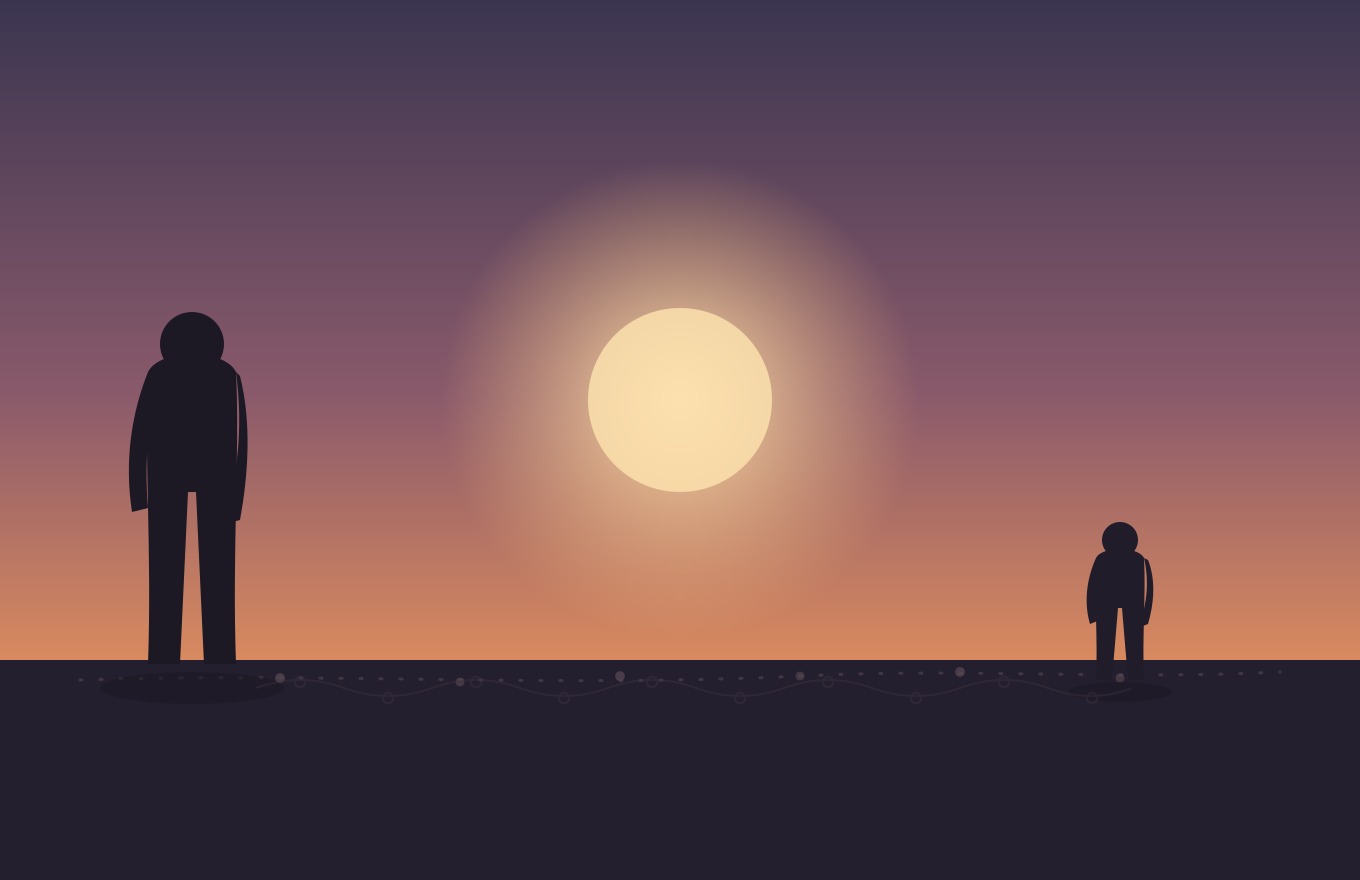
At seventy-five, lying in a hospital bed with a tube in his arm and the ceiling fan turning too slowly to matter, Arun remembered the stick before he remembered the question. That was strange, because the question had outlived every teacher who ever tried to beat it out of him. The stick was long gone — burned, probably, or rotted in some school storeroom in a town he hadn’t visited in sixty years. But the question was still here, sitting on his chest with the same weight as the oxygen mask.
Who is a slave?
He had asked it first at twelve years old, and he was still asking it now, in a room that smelled of antiseptic and overripe bananas someone had left on the side table. Perhaps that was the real answer — not a definition, but a lifetime spent circling one.
He was twelve when he asked his teacher.
The teacher searched his own mind first and found nothing precise enough, so he opened the Cambridge Dictionary on his phone. It wasn’t a difficult question to answer, on the surface. He read the definition aloud. It happened to be the last period of the day — ten minutes from the closing bell, and every child in the room was already halfway out the door in his mind.
A slave is a person who is legally owned by someone else and has to work for that person.
Arun didn’t wait for the words to settle. “So are you a slave to the headmaster? Is my mother a slave to my father? Every relationship I see around us — isn’t it some form of slavery?”
The teacher felt the heat rise in him but caught it in time. I get paid by the government, and the headmaster is my superior — I obey because of hierarchy, not slavery. But why, he thought, am I explaining this to myself for the benefit of a twelve-year-old? So he said only, “There’s a difference between slavery and respecting your seniors and elders. And your parents — that’s a family matter, not something for this classroom.”
The class laughed.
Arun didn’t stop. “I think your mother is also a slave to your father. I’ve seen it.”
That was the line the teacher couldn’t let pass lightly. He struck him with the stick in his hand. “How dare you say that?” he roared.
Arun didn’t flinch, not even from the blow he hadn’t expected. “Your mother had to get pregnant four times to have you,” he said. “The first three were girls. Don’t you remember the story you told us on your birthday — that your parents wanted a boy, and you were the fourth try? Doesn’t that match the definition too?”
That was the end of the teacher’s patience. He slapped him across the face. “Just because I’ve been a little kind to you doesn’t mean you can say whatever you want. I won’t take this anymore. Bring your father tomorrow.” He let out a string of curses, then, almost as an afterthought, threw one more thing at the boy, half punishment and half dare: “You talk too much. Here’s your homework — find me one place, one relationship, where no slavery exists at all. We’ll talk after that.”
He never brought his father. The teacher never asked again. But the homework was never handed in either, because Arun never finished it. He simply kept doing it, for the next sixty-three years.
That evening he walked home past the tea stall, past the temple, past the row of shops closing their shutters for the night, and in every single place he looked, he found the same shape hiding under a different name.
The shopkeeper who smiled at customers and scowled the moment they left — wasn’t he serving people he couldn’t afford to lose? The dog tied outside the god’s place, wagging its tail at the master who fed it once a day — wasn’t that loyalty built on hunger? Even the priest, bowing before the deity, asking for nothing but permission to keep his position — wasn’t that a kind of service too, dressed up in incense and bells?
By the time he reached home, Arun understood something his teacher hadn’t meant to teach him: that the word slavery was too small a cage for what he was looking at, and hierarchy was too soft a word for what it hid. Every bond he could name — teacher and student, wife and husband, worker and government, devotee and god — carried, somewhere inside it, someone who obeyed and someone who was obeyed. The only difference between them was how gently the chain was worn, and how much everyone had agreed not to look at it directly.
A slave only recognizes his condition the moment he acts against his master’s wish. Until then, the chain stays invisible. And in modern slavery, the finer art — the one that looks nothing like slavery at all — is using another person toward your own will without ever letting them feel used. Questioning, disagreement, a difference of opinion: these are the only moments the chain shows itself.
So where does salvation happen? he wondered, twelve years old and already too awkward to say such a thing out loud to anyone but himself. How does the equation become equal again? How does a person rise with dignity inside a bond where the chains are invisible, but pulled tight all the same?
He took the question to his father, because he didn’t yet know that some questions outgrow every answer given to them.
“When you were a child,” his father said, “we took care of you, because we knew what was good for you and what wasn’t. One day you’ll love someone, and she’ll know you better than we did. Then you’ll have children of your own, and you’ll live for them the way we lived for you. And when you finally reach the point where you’re the one guiding and teaching, they’ll treat you the way you once treated your masters.”
“So it’s just another line of masters and slaves?”
“No. Another line of masters and students. There’s a difference, son.”
Arun said nothing more that night. But the difference his father spoke of never fully arrived. It stayed narrow his whole life — a hairline crack he kept pressing his thumb against, waiting for it to widen into something he could name with certainty.
Sixty-three years is a long homework assignment.
He married a woman he loved without reservation, and still felt, some nights, the particular silence that falls over a house when one person’s opinion is worth slightly less than the other’s, and neither of them says so. He raised children he would have died for, and watched them, later, guide their own children with the same soft, well-meaning hand that leaves no room for a different answer. He worked for men he respected, and some he didn’t, and learned that the difference between the two mattered less than he’d assumed at twelve — the shape of the obedience was identical either way. He prayed, sometimes out of love and sometimes out of habit, and could never fully separate the two from the outside.
In modern times, he came to understand, the chain is tied so lightly around the ankle that you forget it is there at all. Most people go a whole lifetime without feeling its weight, because they never pull hard enough in the wrong direction to feel it bite. You call it love. You call it duty, or respect, or the natural order of families and workplaces and gods. It isn’t slavery — it wears none of the old costume, no chains you can see, no auction block, no owner’s name on a paper. And that, Arun understood on his deathbed more clearly than he had at twelve, was precisely what made it so durable. A visible chain invites a fight. An invisible one only invites forgetting.
He never did find a place without it. Not one relationship, not one hierarchy, not one love, in seventy-five years, that didn’t have somewhere inside it a person who yielded and a person who was yielded to. But somewhere in the second half of his life, he stopped searching for the exception and started searching instead for something smaller, and perhaps more honest: the moments when the ones with more power chose, without being forced to, to loosen their grip. Not the absence of the chain — he no longer believed in that — but the grace of a hand that remembers it’s holding one.
That, he decided, lying in the hospital bed with the fan turning too slowly to matter, was as close to salvation as the question ever came.
He had stopped believing, since the age of twelve, that the absence of a name for something meant the absence of the thing itself. He died still believing that. It was, in the end, the only inheritance he was certain he’d earned.


Deep